
The board gets your name noticed
Inside the places your customers already go, every day, without an app in the way.
Board AdsEvery customer starts the same way. They notice your name, they look you up, and they pick the business that is easy to reach.
This page explains how that works today, in plain words, and where most local businesses lose people without knowing it. No sales talk. At the bottom is the check we run on any business, free, before we recommend a thing.
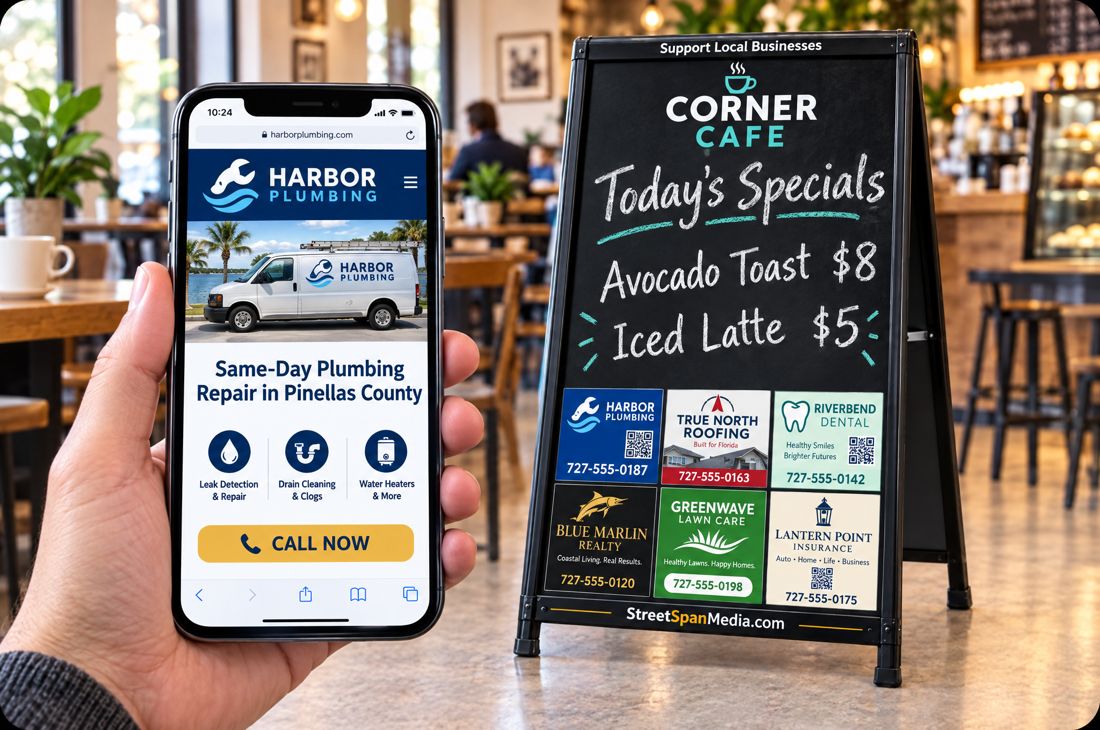
Nobody wakes up and types your name into Google. They hear it first: a sign, a board, a neighbor, a van on the road. Then they check.
Where these numbers come from: the OAAA and Harris Poll retail out-of-home study (2026), the BrightLocal consumer surveys (2026), and the CallRail consumer survey (2025).
When someone searches "plumber near me", Google weighs three things to decide which businesses go on the map. How close each one is to the person searching. How well the listing matches what was typed, which comes down to the category and services on the profile. And how well known the business is: the number and freshness of its reviews, how often it is mentioned elsewhere, and whether other sites link to it.
That is why a business in Palm Harbor can show up for a search made in Tarpon Springs, and a Tarpon Springs business can miss it. Distance is only one of the three, and it is the one nobody can change.
Most businesses that are missing from the map are missing for a boring reason. The listing was never claimed. The category is wrong or too vague. The hours, phone number or address do not match what is written on the website or on Yelp. All of those can be fixed in an afternoon. What nobody can do, whatever they tell you, is promise a position.
Your Google Business Profile is the listing, not the website. It is the box with your hours, phone, photos, reviews and a map pin that appears when someone searches your name or your trade nearby. It is free, and for most local businesses it is seen far more often than the website.
It holds your primary category and the services under it, your hours including holidays, your phone and address, photos, short posts, and every review with your reply. The two most common faults we find are wrong hours and a missing or vague category. Both are enough to keep a business off the map for the searches that matter.
The other quiet killer is mismatch. Your name, address and phone need to read exactly the same on Google, Apple Maps, Bing Places, Yelp, your social media pages and the chamber of commerce page. "Suite 4" on one and "Ste. 4" on another is enough for Google to treat them as two different places. Profile setup is part of every website job we do, and it comes first.
Reviews are read by people and counted by Google, and the two want different things. A person wants to see that the last few were recent and real, and that someone answered them. Google wants a steady flow: ten reviews spread over a year count for more than ten in one week, and a reply to each one tells it the business is alive.
The way to get them is to ask at the right moment, which is right after the job, while the customer is still pleased. A text that says thank you and carries a link that opens the review box in one tap gets answered. An email a week later does not. Never buy reviews and never write them yourself: Google removes them, and sometimes the whole profile with them.
Asking by text after every job is one of the pieces of the system we set up behind a website. It runs on its own once it is switched on.
A search engine does not look at your website. It reads it, top to bottom, like a quick reader in a hurry. So the headings have to say what you do and where, in the words a customer would type: "Water heater repair in Palm Harbor" works, "Solutions for your home" does not. Each section should make one point, and the first sentence should make it.
The same name, address and phone as your listings, written the same way. Pages that load fast on a phone. A phone number that dials when tapped. No dead links. None of that is clever; it is the difference between a site Google trusts and one it skips.
The newer answer engines, ChatGPT, Gemini and the AI answers at the top of Google, read the same pages and the same reviews, then write a short answer instead of a list of links. They lift from pages that answer a question plainly in the first sentence, which is how this page is written. There is no way to pay for a place in those answers. The websites we build are written this way from the first page.
This is why a website is not just a website. Two sites can look the same on a screen and be read completely differently by Google. One has a page for each service, headings in the customer's words, and the tags behind the page that say what the business is, where it is and when it is open. The other is pictures and words, and only people who already have the link will ever see it.
That is also why a small site is not a handicap. One or two pages with the right structure can come up for the searches that matter in a town, and more pages, one per service, cover more of those searches. How it is built is what counts, and that is the part a $200 website leaves out.
Before we recommend anything, we look your business up the way a customer would and the way Google does, and hand you a full written report. We call it the Presence Check. This is everything it covers, and you can run most of it yourself tonight.
You get a full written report, not a checklist: every listing we found, what is wrong on each one and exactly what to change, who holds the login, where you stand against the businesses nearest you, and what to fix first. It is done before the call, from the business name and website on the booking form, so the fifteen minutes go to what we found rather than to collecting it. It is free, and it is yours to keep whether or not you hire us for anything.
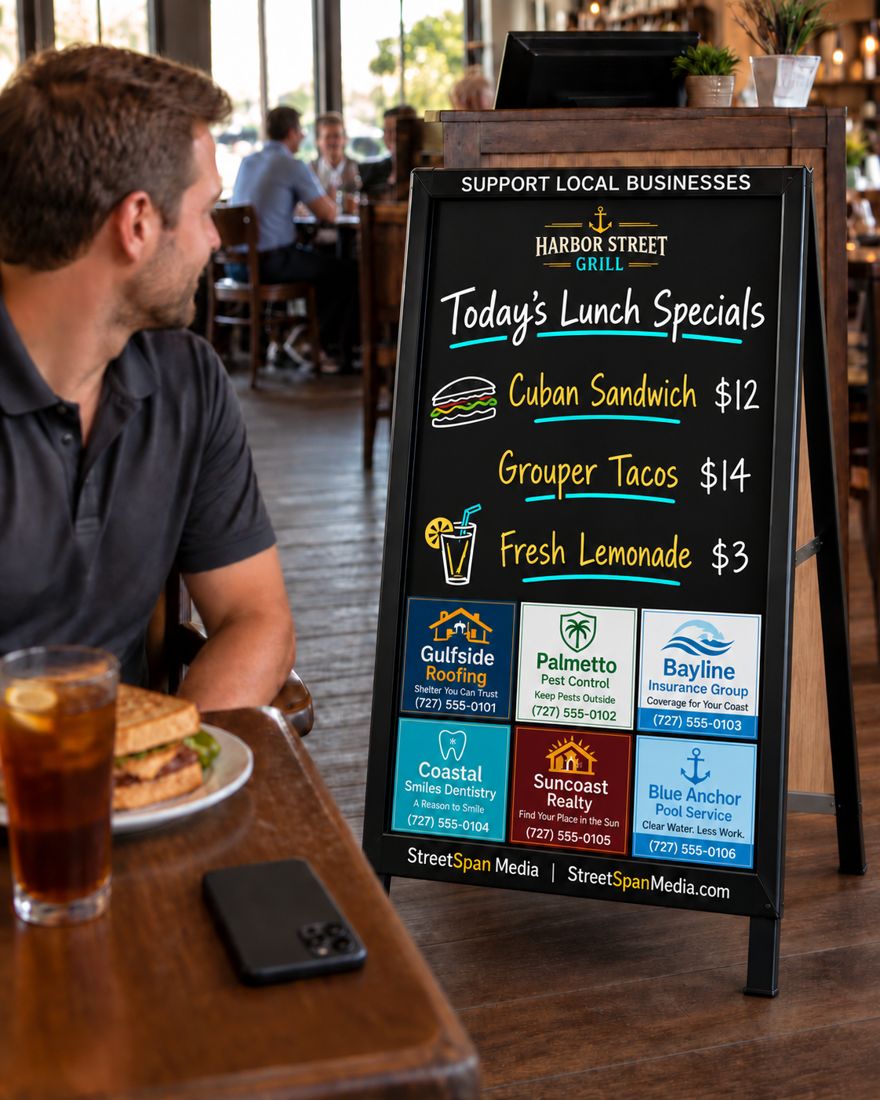
The free things come first. Claim the profile, fix the listings, ask for reviews, join the chamber. Do those before you spend a dollar on anything. Then the question is how people hear your name in the first place.
Own a shop with walk-in customers? The board is free for you.
Most businesses have one of the three. The ones that grow have all three, and each piece makes the others work harder.
Inside the places your customers already go, every day, without an app in the way.
Board AdsRight category, matching details, steady reviews, a site that says what you do and where.
WebsitesEvery call answered, every missed call texted back, every lead followed up, from one inbox.
What Is IncludedClaim your Google Business Profile, verify it, pick the right primary category, and add your hours, phone, services and photos. Then make sure the name, address and phone match what is on your website and your other listings, to the letter. It costs nothing, and it is the single biggest step.
Usually one of three things: the category is wrong or too vague, the address is a PO box or hidden, or the name, phone and address do not match your other listings. New profiles also take a few weeks to settle. Fix the three, then give it time. Nobody can force the position.
Claim and fill your Google Business Profile. Get listed on Apple Maps, Bing Places and Yelp with matching details. Ask every happy customer for a review. Join the chamber of commerce. Post what you are doing on your profile and your social accounts. Those cost time, not money, and they come before any paid advertising.
Three things move it: a complete profile in the right category, steady recent reviews with replies, and a website that says plainly what you do and where. Being talked about elsewhere helps too, which is where a name people see around town comes in. Searches for your name tell Google people know you.
Inside the places your customers already go. A specials board in a busy shop, a local sponsorship, the chamber, a community paper. The question to ask of any of them is how many of the right people see it each week and what it costs per day. A StreetSpan board spot runs $1.64 a day.
Make sure people hear your name. Make sure what they find when they look you up is good: the profile, the reviews, the website. And make sure you pick up when they call. Most businesses have one of the three covered. The ones that grow steadily have all three.
Yes. Facebook shows your page mostly to people who already follow you, and Google barely reads it. A website is what shows up for "plumber near me", and it is where your profile, your board ad and your reviews all send people. It can be small. It has to be yours.
They read the same things Google does: your Google profile, your reviews and the words on your website, plus mentions of you on other sites. They favor pages that answer a question plainly in the first sentence, and businesses whose details match everywhere. There is no way to pay for a place in those answers.
Tell us about your business and what you want more of. You get a straight answer on what would help and what it costs. No pressure.
Book a Free Call